
Day 2 - Locus of Control

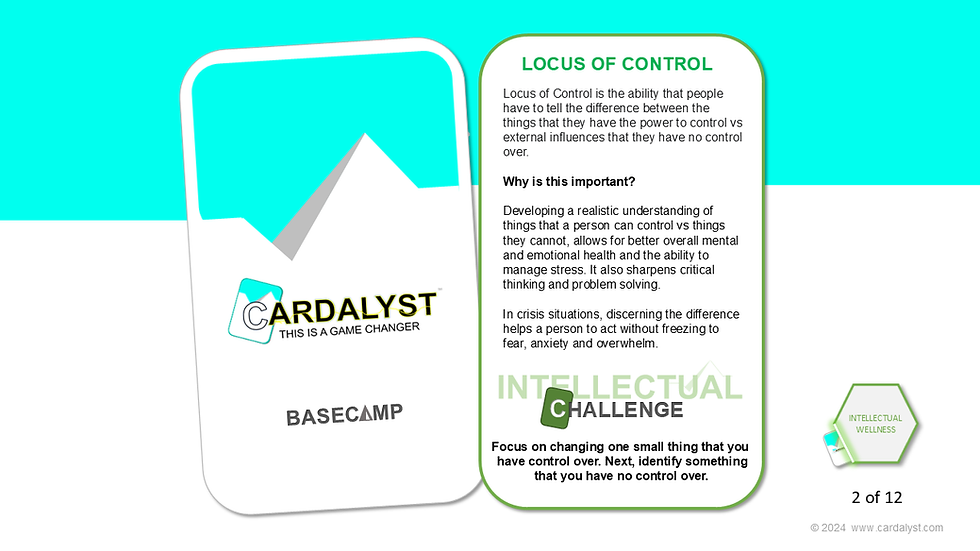
Today's challenge:
Focus on one thing that currently stresses you out. What can you control? What is beyond your control? Ignore what you can't control and take a small step to improving what is in your power to act upon or change.
The term “locus of control” was introduced by psychologist Julian B. Rotter in 1954 as part of his social learning theory. It describes how individuals interpret the causes of events in their lives—whether they believe outcomes are shaped by their own actions or by external forces. This has roots in very ancient concepts dating back to the writings of Epictetus (c. 50-135 CE) and is central to the philosophy of Stoicism.
What is this?
Internal Locus of Control
You believe your actions, decisions, and efforts directly influence outcomes.
Example: “I didn’t get the job because I didn’t prepare well enough.”
Caution: Be mindful not to blame yourself for things truly outside your control (e.g., natural disasters, systemic issues), as this can lead to guilt or burnout.
External Locus of Control
You believe outside forces—like luck, fate, or other people—are responsible for what happens.
Example: “I didn’t get the job because the interviewer was biased.”
Caution: Believing everything is out of your hands can prevent growth and lead to learned helplessness.
Why is it important?
Here’s the fascinating part: what you believe caused an outcome often matters more than whether it’s objectively true.
Why? Because locus of control is a perception, not necessarily a reflection of reality—and that perception is powerful.
Beliefs Shape Behavior. If you believe you have control (even if it’s partial), you’re more likely to take action, persist through challenges, and learn from mistakes.
Empowerment vs. Helplessness. Believing you have no control—even when you do—can lead to passivity, anxiety, or depression.
Resilience. People with an internal locus tend to bounce back faster because they believe they can influence future outcomes.
What are some things you can do to leverage locus of control ?
Focus on What You Can Control. Even in tough situations, identify actions you can take. This builds confidence and reduces helplessness. If something is truly beyond your influence, let it go and redirect your energy.
Reflect on Your Beliefs. Ask yourself: Do I often blame others or circumstances? If so, challenge that thought. What part did you play?
Set Goals and Track Progress. Seeing your efforts lead to results reinforces the belief that you have control over your life.
Learn from Setbacks. Instead of chalking up failure to bad luck, ask: What can I learn? What can I do differently next time? How should I respond to things I can’t control?
Practice Accountability. Own your decisions and outcomes—good or bad. This mindset fosters growth, self-awareness, and personal development.
Deep Dive

"Meditations", by Marcus Aurelius
Marcus Aurelius was a Roman emperor who wrote Meditations as a personal journal, not for publication. His consistent habit of self-reflection shows how regular introspection can strengthen character and clarity. His writings value consistency and introduce Stoic principles of virtue, self-control, rational thinking and locus of control.

Waypoint:
"If it is not right, do not do it; if it is not true, do not say it.” - Marcus Aurelius


Comments