
Day 7- Leadership

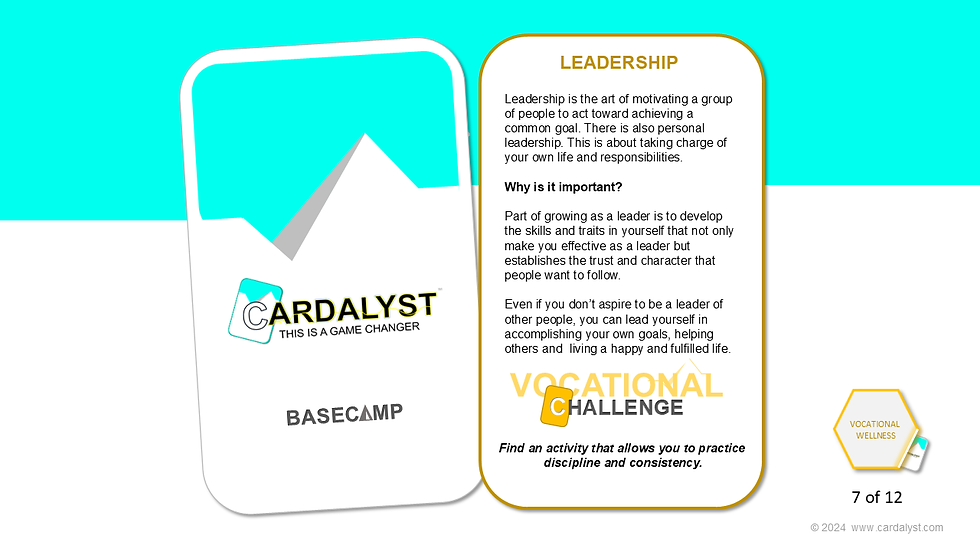
Today's challenge.
Find an activity that allows you to practice discipline and consistency.
What is this?
Leadership is the art of motivating a group of people to act toward achieving a common goal. There is also personal leadership. This is about taking charge of your own life and responsibilities. Part of growing as a leader is to be always ready to expand your capacities and strengths. It is also about having the courage to speak up even when you are not sure of yourself.
Why is it important?
It comes down to a fundamental choice; Are you in control of your destiny or does it control you?
If you are content to go through life and accept what it brings your way, leadership may not be too important to you. On the other hand, if you want to dictate (as best you can) where you want to go and how you want to craft your life, then leadership skills can apply to both your personal goals and if you ever want to lead others.
How can you improve your leadership abilities?
You will notice many leadership principles are built into Basecamp. All of them are built into the rest of the Cardalyst system.
1. Increase Your Self-Awareness
This was introduced last week. Leadership starts with leading yourself.
Ask yourself regularly:
What are my strengths?
What are my blind spots?
How do others experience me?
What habits help or hinder my effectiveness?
Seek honest feedback from colleagues, friends, mentors, and supervisors. Self-aware leaders tend to make better decisions and build stronger relationships.
2. Practice Strategic Judgment
A leader's job is not merely to make decisions, but to make good decisions consistently.
Great leaders balance:
Thinking and action
Courage and caution
Vision and practicality
As you have discussed before, strategic judgment is often what separates managers from true leaders.
3. Develop Influence, Not Authority
John C. Maxwell's book " The 21 Irrefutable Laws of Leadership" states:
"The true measure of leadership is influence, nothing more, nothing less."
Focus on:
Building trust
Keeping commitments
Communicating clearly
Helping others succeed
When people trust you, influence naturally follows.
4. Become a Student of Leadership
Leadership growth requires continual learning.
Start with the book recommendation below.
5. Build Consistency
People follow predictable leaders.
Consistent leaders:
Keep their word
Show up reliably
Control their emotions
Live their values
Trust is built through repeated actions, not occasional excellence.
6. Learn to Add Value
One of Maxwell's most important principles is the Law of Addition:
Leaders become more effective when they focus on helping others succeed.
Ask daily:
Who can I help?
Who can I encourage?
Who can I mentor?
How can I make someone else's job easier?
Leaders who serve create loyal followers.
7. Improve Communication
A brilliant idea has little impact if it is poorly communicated.
Practice:
Active listening
Asking good questions
Public speaking
Writing clearly
Storytelling
Many leadership problems are actually communication problems.
8. Develop Others
The highest level of leadership is creating more leaders.
Instead of asking:"How can I do this myself?"
ask:"Who can I develop to do this?"
9. Embrace Discomfort
Leadership growth occurs at the edge of your comfort zone.
Volunteer to:
Lead projects
Facilitate meetings
Speak publicly
Resolve conflicts
Mentor new employees
Confidence comes from experience, not from waiting until you feel ready.
10. Lead With Purpose
The most effective leaders know:
What they stand for
What they are trying to achieve
Why it matters
Purpose creates clarity.
When challenges arise, purpose keeps you moving forward.
A Simple Daily Leadership Practice
Spend 15 minutes each day:
5 minutes learning (read or listen to a leadership resource)
5 minutes reflecting (What went well? What could improve?)
5 minutes serving (Send encouragement, mentor, or help someone)
Do this consistently for a year and your leadership ability will likely grow more than through any single course or certification. Get involved. Find a cause you are passionate about. How can you make a difference?
Deep Dive

"The 21 Irrefutable Laws of Leadership" by John C. Maxwell
Maxwell argues that leadership is not primarily about authority, position, or title. It is about influence, and effective leadership can be learned through a set of timeless principles. His position is that strong leadership amplifies talent, strategy, and effort. Weak leadership limits potential,
regardless of how capable people may be.

Waypoint:
“A leader is one who knows the way, goes the way and shows the way”. - John
C. Maxwell


Comments